This is what I upgraded to.
It's Canon's EOS D60, a proper single lens reflex (SLR) flip-up-mirror removable lens camera that happens to be digital. It's the successor to the already very good EOS D30, and it's a very capable picture-taking object, as you'd want it to be for the $US2200 or so that the basic kit will cost you.
That's without a lens, by the way; the D60 will work with any EF-mount lens (including Canon's own selection, and lots of others), but a few decent lenses will pump the price up considerably more. Skimp on the lenses and you might as well not have bought the fancy camera in the first place.
And then there's CompactFlash memory cards for image storage, and other extra bits and bobs. All of which drive the price of a whole-box-and-dice D60 rig, here in Australia, up far enough that you're more than half way to paying for a basic new car.

I, arguably at least, need this camera. No, really. I do. Honest. Gadget-lust was not a factor in my purchasing decision. Not even slightly. I'm not sitting here fondling the D60 with one hand while I type with the other. Not at all.
Whether or not I need the thing, you, probably, don't.
Digital photography's mature enough now, though, that there is a digital camera out there to suit most photographers. It just isn't this one. In the course of this rather rambling - even by my standards - review of the D60, I'll talk about what different kinds of digitals offer, how film cameras compare, and what matters and what doesn't when you're trying to decide whether to drop the price of a new mouse on a cheerful little baby digital, or a little bit more money on a well-maintained all-manual Leica 35mm film camera with lenses, or rather more again on a modern auto-everything 35mm, or the price of a new PC on a fancy integrated-lens digital, or the price of a good used car on a pro camera.
This isn't going to be the weirdest camera review ever; other people have pretty much sewn up that category. If you just want a straight review of the D60, though, then this ain't it. Phil Askey's review here is what you want. Phil's site is the place to go if you've just hit someone over the head and stolen their nice digital camera, and now need to read a review that's comprehensive enough that you won't miss the manual.
So, assuming that you're happy reading another 100% Genuine Brain-Dump From Dan, let's proceed.

Filthy lucre
I made a serious effort to scam a loaner D60 from Canon Australia, but prolonged correspondence led me to the conclusion that they didn't actually have any cheese at all, at least as far as the D60 was concerned.
Fair enough, really; the D60 is a product that Canon are selling as fast as they can make it. In a situation like that there's no reason for a manufacturer to bother sending cameras to reviewers at all, until production meets the existing demand.
Lenses, Canon could lend me, but I decided to pass on that. They wanted to give me a selection of pricey glass including the monster EF 400mm f/2.8 L image stabilised USM, which is a 6.73 kilogram $AU17,000 behemoth (the second most expensive lens Canon make that isn't available only on special order...) which I'd have to buy a new tripod to even use. If I were into nature or sports photography, or if I were a career pervert, I might have found the thing very appealing. But I'm not, and my fear of dropping it outweighed my desire to play with it.
The upshot of all this is that I (gulp) actually paid for my whole D60 kit. Retail, yet. I feel so ashamed.
The Australian retail price for the D60 is currently $AU5499. For the nice round price of $5199.48, I bought a package deal from DirtCheapCameras here in Australia, which included the standard D60 kit, plus a second battery (the D60's charger has slots for two of its little lithium ion packs, but charges them one at a time), a BG-ED3 portrait grip, and a 192Mb SanDisk Ultra CompactFlash card.
The "Ultra" cards sound as if they should be fast, but they're actually slower than various cheap yum cha CF cards. But the difference isn't crippling, and the price was right. For the battery, grip and memory card I was only paying $AU349 extra; US discounters were charging about $US260 ($AU480 or so, as I write this) for the battery and grip alone. I presume DirtCheapCameras must have rather more BG-ED3s sitting around than they know what to do with.
Incidentally, DirtCheapCameras is the cut-price reduced-catalogue online presence of the Chatswood Impact Camera House store, here in Sydney. You can place an order on the DirtCheapCameras site and pick it up from the Chatswood store, adding stuff that you can't buy online. Well, you can if you're placing a hefty order, anyway; the Impact people are, understandably, less likely to go out of their way for smaller spenders.
I also got a Manfrotto 190PRO tripod (in the US, it's the Bogen 3001PRO) and neat-o grip-action 222 ball head (Bogen 3265). My old tripod was a super-light, ultra-cheap little integrated-head horror from Velbon; the Manfrotto gear is almost alarmingly superior.
If you've got a zoom lens - with or without spooky image stabiliser - and want to be able to use it for anything but very short exposures, you'll need at least one good tripod. I use mine more for close-up product shots, but the principle is the same; lots of magnification means lots of vibration sensitivity.
A rattly aluminium cheapo-tripod is good enough for most digitals, because they don't have enough resolution that the relatively small amount of movement that gets through to the camera matters. Once you've got 3000 by 2000 resolution, though, suddenly there's a reason to get something decent, beyond mere pose accessory collecting.
My Manfrotto tripod's cheap, compared with the real vibration-deadening kings; many photographers drop several hundred bucks on a wooden tripod, which is an excellent choice for muscular people, or those who don't take a lot of pictures on mountains. Carbon fibre tripods are feather-light and also have very good damping, but they're even more expensive than wood. For wind-shake resistance, super-light tripods can be temporarily weighted down with a bag (which you carry with you) full of dirt or pebbles (which you don't); that's the option many mobile photographers take.
My spending frenzy was not concluded. I got an RS-80N3 remote switch (a cable release, basically, but with a three-pin plug instead of a length of bicycle brake cable or a pneumatic tube), and a 550EX flash. And a nice Lowepro bag, which isn't quite as attention-getting as those bags that say SONY or TOSHIBA or something in six inch luminous letters, but which still qualifies as a Steal-Me Bag.

The 550EX is a fancy flash which, naturally, integrates with the D60's exposure metering, but which also has full manual control including stroboscopic flash and so on, zooms with your lens, and can also be used as a separate slave flash. Put a 550EX on your camera, and more compatible flashes nearby on the little stands that come with them, and you can trigger the others along with the master one; they communicate via infrared. The IR transmitter fires through the flash lens and has a range of ten to 15 metres.
Fortunately, your slave flashes don't have to be the expensive 550EXes. The cheaper 420EX can work as a wireless slave, but not as a master...


Types of digital camera
There are a lot of other digital photographic options. Most of them won't require you to sell your immediate family to afford them.
There are four main categories of dedicated digital still cameras - as opposed to camcorders that can take still pictures, and other such oddities.
First, there's toy cameras. It's actually a bit mean to call these things toys; they do take pictures, and they can take very good ones in the hands of someone who knows how to use them. But they don't have a lot of resolution (1024 by 768 at the outside, these days, and more commonly 640 by 480), seldom have a flash, never have a zoom lens or a screen on the back for you to review your pictures, generally have lousy optics, and very probably don't have removable storage either, so you're stuck with however much memory is built into them. Toy-digicam prices start well below $US100, and for the money, they're often great little gadgets. But general purpose cameras, they are not.
Then, there are consumer cameras, costing from a couple of hundred US dollars to around a thousand. To make it into this category, a camera must have a flash and a screen on the back for image reviewing, ought to have removable storage and a zoom lens (digital zoom that just crops out the middle of the image doesn't count), and really should have autofocus as well; I talk about the limitations of "focus-free" lenses in my old camera review here.
A consumer camera is all that most people need, and it can be a handy adjunct for a pro photographer as well - a lot of pros have now added things like the nicer Nikon Coolpix models to their camera bags.
Next, there are "prosumer" cameras, which don't have the full feature sets that professional photographers want from their main cameras, but which can be used for a lot of pro photography nonetheless. There's no really clear line between consumer and prosumer cameras, but prosumer models generally have all of the possible consumer camera features, more resolution, higher quality lenses, more zoom, and various other extra bells and whistles. Prices range from below $US1000 to the thick end of $US2000. Prosumer digicams don't have removable lenses, but, at a glance, you could be forgiven for assuming that some of them did.
My C-2500L was a prosumer camera when it was new. Now, there are entry-level consumer digitals that can beat the 2500L in several departments, and current prosumer cameras are way ahead of it.
Buying a consumer or prosumer digicam is, in many ways, like buying a point-and-shoot film camera. You get a camera. It's got a lens on it. That's the only lens you get. It probably has half-decent zoom, it probably has a perfectly acceptable maximum wide angle setting, it probably has OK close-up capability. It will have more distortion and chromatic aberration than a separate lens for a more serious camera, but most photographers aren't likely to notice the difference, and the whole integrated-lens camera may cost quite a lot less than a mere lens for a camera like the D60.
There are plenty of worthwhile extras you can buy for an integrated-lens digicam - more batteries, a cheap tripod, maybe an external flash, maybe screw-on filters and wide-angle adapters and teleconverters - but you'll have to try pretty hard if you want to spend the price of the camera again on all that stuff.
You will face no such problems if you buy something in the last digicam category - true professional digital cameras. When you get a pro digital, whole new money-eating vistas open up.
Pro digicams generally look like high-end 35mm cameras, and accept the same lenses. The image sensors in pro cameras are almost all smaller than a 35mm film frame, though, so they can only see the middle bit of the image from the lens. This gives them a "focal length multiplier"; whatever lens you use will behave as if it's more telephoto than it is on a 35mm film camera. The smaller the digicam's sensor, the bigger the multiplier will be. The EOS D60's focal length multiplier is 1.6, so a "50mm" lens on the D60 will give you the same field of view as an 80mm lens on a 35mm film camera.
The Contax N Digital (which currently costs around $US7000) has a full-35mm-frame-sized sensor, and other pro cameras will no doubt have them in the future. But focal length multipliers are still the norm.
Pro digitals don't come with a lens. All you get in the standard kit is the camera body, to which you can attach a variety of lenses, just as you can with normal 35mm SLRs.
You can easily pay the price of the D60 again for a lens. Heck, you can pay four or five times its price, if you develop a hankering for a stabilised super-telephoto suitable for mounting on heavy siege equipment. It's possible to use very inexpensive lenses with cameras like the D60, but it's unwise.
This is partly because the EOS D60 is actually cheap, for a pro digicam, and it lacks a few features that pros often want. But since it's less than half the price of the fancier pro digitals, its shortcomings are forgivable.
Lenses
Because the D60 lets me swap lenses, I can get super-magnified shots, quite extreme wide angle pictures, and stopped-down very-high-depth-of-field long exposures, with minimal distortion. Someone like me who takes a lot of pictures of technological objects, but doesn't have a proper photo studio to take them in, can really use a multi-lens camera.
That's my story, and I'm sticking to it.
The D60's 1.6X focal length multiplier - or "field of view crop", depending on whether you're a glass-half-full or glass-half-empty sort of person - makes lens choice somewhat problematic. The only way to get a really wide wide angle out of the thing is by starting with an amazingly wide angle lens; some sub-20mm oddball-lens which could profitably be used by an old gypsy woman to tell fortunes when you're not busy taking pictures.
So I bought one of those. And some others.

If you click on the above image, you'll get a 520 pixel wide version. If you want to see the full image from the camera, and you're happy about waiting for the download and winding up my server bandwidth consumption, click here.
There's one thing about the D60 that sets it apart from every other digital camera on the market today, at any price, not counting exotic refrigerated astrophotography cameras. That thing is its long exposure performance.
Digital cameras are, generally speaking, rubbish if you want to take pictures with exposure times of more than a few seconds. This is because the individual cells on their image sensors don't have identical sensitivity.
Over a normal exposure time - 1/60th of a second, say - some sensor cells may be, say, 1% brighter than they should be, for the amount of light they're receiving. Big deal.
Do a one second exposure, though, and the slightly more sensitive cells will now be 60% brighter than they should be, and will probably cause a "hot" pixel in the image. Go up to exposures of about a minute, and even very slight sensitivity differences will cause tons of noise in the final image. The warmer the sensor is, the worse this problem will be; many image sensors are noticeably brighter on one side or corner, which is the part of the sensor that's closer to warm camera electronics. Refrigerating the sensor with a Peltier device or, in extreme cases, liquid nitrogen, can solve this problem; digital astrophotographers do exactly that for their very long exposures of the sky.
If you want a digital camera that doesn't need to be connected to a mains power supply or a frosty pipe, then long exposures are a problem. Many digicams deal with hot pixels by automatically taking a second, shutter-closed picture of the same length as the first one when they're in long exposure mode, and then subtracting that second "dark field" shot from the previous one. The hot pixels in the dark field image will be the same, everything else will be black, and bingo, the hot pixels are deleted. You can do this "dark field subtraction" trick with cameras that don't have such a feature; just manually take a second shot with the lens cap on, and do the subtraction in an image editing program.
Unfortunately, dark field subtraction won't get rid of genuinely random sensor noise, which will always be present. It also doesn't give you back what should have been in the hot pixel spots.
The D60 does not use dark field subtraction.
So far as I can see, it uses magic goblins. Very competent magic goblins.

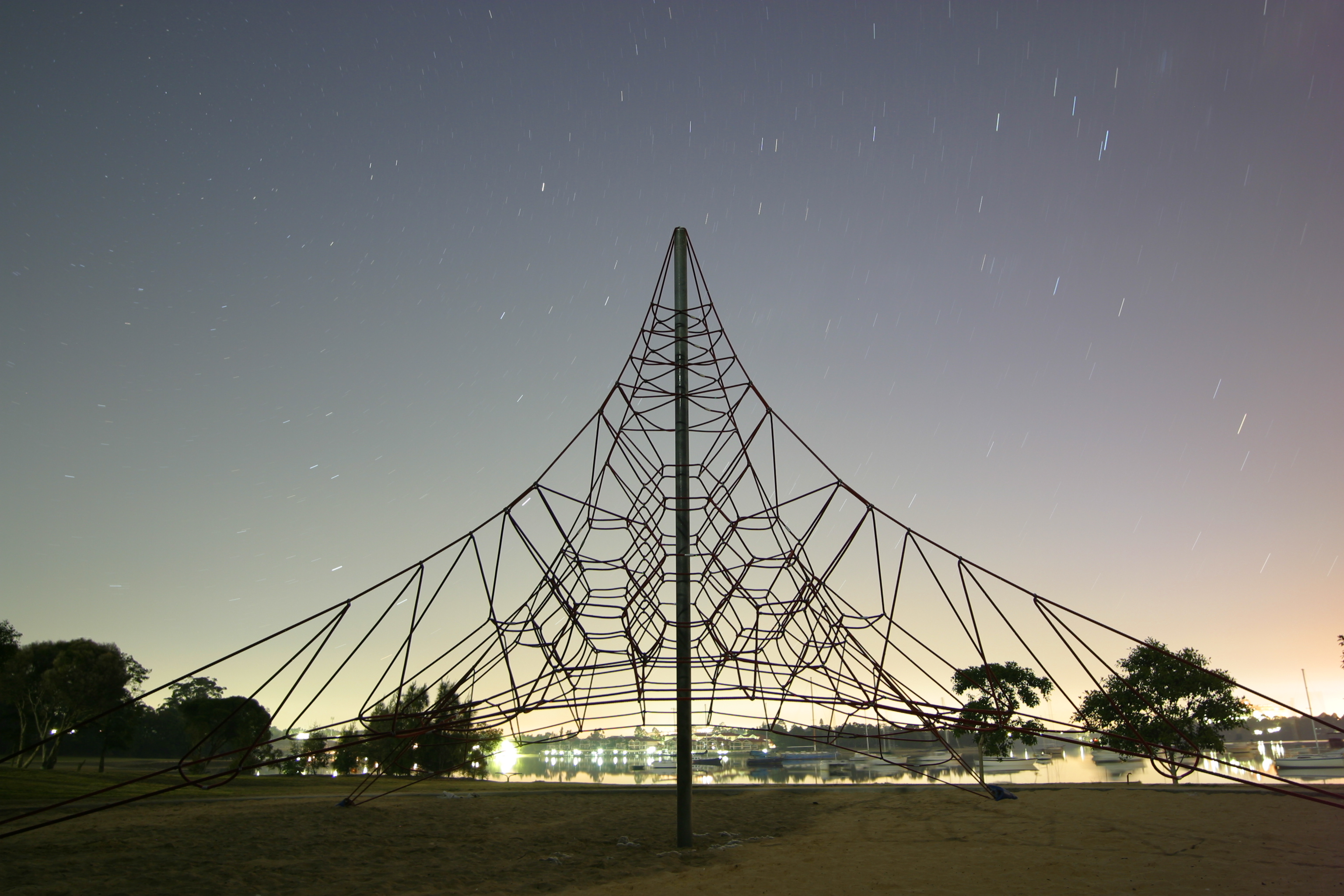
This, as the star trails in the sky indicate, is a five minute exposure taken with the D60, of a piece of play equipment in a local park in the wee small hours of the morning. The moon was just coming up behind me; it was about as dark as it ever gets in metropolitan Sydney. If you want the full image (only 1.93Mb, thanks to the lower amount of detail in this shot), you can get it here. The image is practically noiseless.
A clean star-trails picture from a digital camera that you can carry around is pretty darn astounding. A bit of back yard experimentation revealed that the no-noise exposure time limit for the D60, at its lowest sensor sensitivity setting of ISO 100, was about fifteen minutes. That was in winter, mind you, with an ambient temperature of around ten degrees Celsius (what passes for cold, here in Sydney). I've now been able to test the D60 on a summer night as well, with an ambient temperature above 20 degrees C; at that temperature, the noise-free exposure time drops to about five minutes.
Neither of these numbers are impressive compared with film, which doesn't have any significant nonlinearity problems at all if your camera doesn't leak light and you're not taking pictures somewhere rather radioactive. But for a digital, five minutes is very impressive and 15 is downright amazing; if your ambient temperature is lower, you may be able to manage even longer clean exposures. 15 minutes at ISO 100 is a worthwhile exposure for astrophotography purposes.